The day I gave birth to our second daughter, our little family overflowed with joy. My older child, four-year-old Lisa, was trembling with excitement as she waited to hold her baby sister for the first time. She kept whispering, “She’s finally here, Mama.” We imagined a perfect meeting, the kind filled with smiles and happy tears. But the moment the baby rested in her arms, Lisa paused, focused on her tiny face, and said something that stopped every heartbeat in the room. What was supposed to be the most beautiful moment suddenly carried a weight I never expected to feel.
I had dreamed of the day my two daughters would meet.

Lisa had spent months talking to my belly, singing to it, and offering her favorite toys “for the baby.” She was convinced her little sister would come out already wanting to play dolls with her. That morning in the maternity room, when they finally brought the baby to me, Lisa climbed onto the bed with a seriousness I had never seen in her. She adjusted her red overalls, straightened her ponytail like she was preparing for something important, and waited.

When the nurse placed the baby in her arms, Lisa held her breath. She stared at her sister’s tiny face, the thin lips, the small fingers curled like a rosebud. Her hands shook slightly. I thought she was just nervous… until she looked up at me, confused.
“Mama… her head is broken.”
My heart froze.
“What do you mean, sweetheart?” I tried to smile.

Lisa traced the baby’s misshapen skull with one finger, a shape I had noticed too but tried to ignore. “It looks like someone squished her,” she whispered, her voice cracking.
Before I could answer, the doctor stepped closer. His gentle expression had changed. The joy we’d been celebrating seemed to fade from his features. He cleared his throat like someone preparing to deliver bad news.

“We’ve noticed something unusual,” he said softly. “Your daughter’s head size and shape suggest a possible genetic condition. We’ll need more tests.”
The room stopped breathing.
I clutched the sheets beneath me as if they could keep me from falling apart. Lisa looked from me to the doctor, confused by the sudden silence. All she understood was that something was wrong with her sister.
“Mama, is she hurt? Did I do something?” she whispered, devastated.
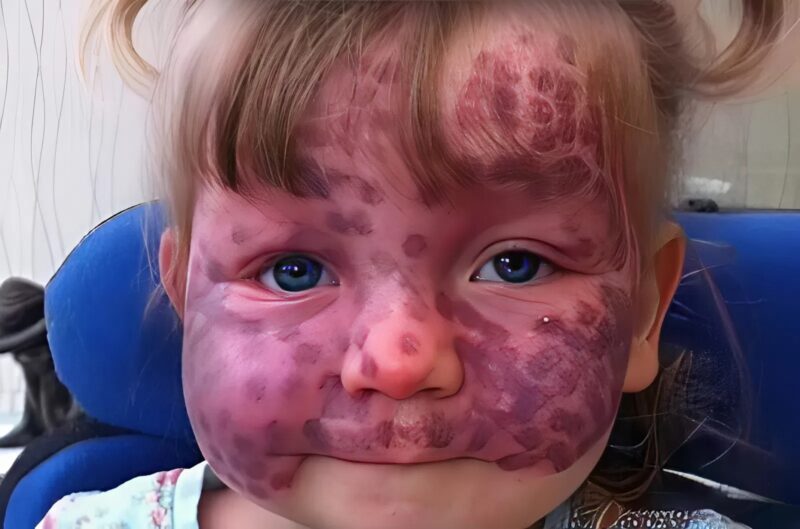
That question shattered me harder than the doctor’s words. I hugged her tight, and the baby pressed between us let out a tiny sound—almost like a cry of protest, a cry for life, a cry demanding love anyway.
“No, sweetheart,” I whispered into her hair. “No one did anything. Your sister is perfect. We just need to make sure she stays healthy.”
The doctor spoke again, but I barely heard him. All I could do was watch my older daughter, small and scared, realizing that her dream of a perfect sister had changed in one single moment. And yet, even with fear in her eyes, she gently kissed the baby’s forehead.
As if love didn’t need explanations.