Something happened to my child that left me completely stunned. I never imagined I would experience such a heartbreaking and unforgettable moment.
The moment I first held my newborn baby in my arms, I thought my heart might burst with happiness. His tiny fingers wrapped around mine, his little chest rose and fell gently, and his soft cries were the sweetest sound I had ever heard. 🥹❤️👶 I had spent nine months imagining what he would look like, wondering whose nose he would inherit and whether he would have his father’s smile. But nothing could have prepared me for what I noticed when I looked closely into his face.
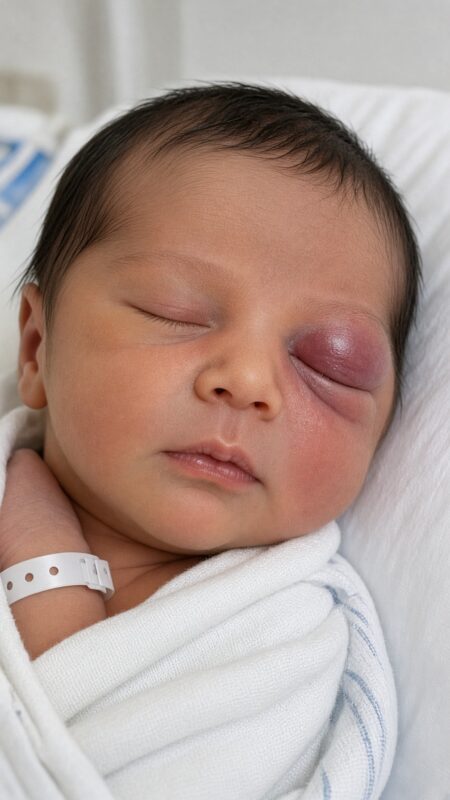
One of my baby’s eyes was a beautiful, pale blue. At first, I thought it was simply a reflection of the hospital lights. Newborn babies often have eyes that change color as they grow, and I convinced myself that everything was perfectly normal. But when I looked again, I noticed something unusual. His other eye looked different, and the blue eye seemed strangely fixed. It was as though he wasn’t focusing on the world around him. 💙👁️
«Look at his eyes,» I whispered to my husband, Daniel, trying to hide the worry creeping into my voice.
He leaned over the hospital bed and smiled at our son. «He’s beautiful. Maybe he’ll have blue eyes like my grandfather.»
I wanted to believe him. I desperately wanted those words to be enough. But something inside me kept insisting that I should ask a doctor. 💔
Later that afternoon, a pediatrician came to examine our baby. She gently moved a small light in front of his face, observed his reactions, and checked whether his pupils responded normally. At first, she remained calm, but then she repeated the examination. Her expression changed slightly, and she asked another specialist to come into the room.
My heart began pounding.
«Is something wrong with my baby?» I asked.
The doctor paused before answering. «We’ve noticed that one of his pupils appears unusually pale, and his visual responses aren’t quite what we would expect. This doesn’t automatically mean something serious, but we need to investigate it carefully.»
I felt the room spinning around me. 😢🏥
The doctors explained that an unusually pale or white-looking pupil in a newborn can sometimes indicate an eye condition that requires urgent investigation. It can have several causes, including congenital cataracts, abnormalities of the retina, or other disorders affecting the eye. In some cases, the problem may also be associated with an underlying neurological condition.
They emphasized that a blue iris alone is not evidence of neurological damage. What concerned them was the unusual appearance of the pupil and the way our baby responded to visual stimulation.
Our son was examined by a pediatric ophthalmologist, who carefully checked the structures inside his eyes. The specialist then recommended further testing because some of his reactions suggested that the doctors needed to investigate how his visual pathways and nervous system were functioning. 👶🔎
The following morning, we met a pediatric neurologist.

She explained that the brain and eyes work together to process what a baby sees. The optic nerves carry visual information from the eyes to the brain, where it is interpreted. If the optic nerves, visual pathways, or certain areas of the brain develop differently, a child may have difficulty tracking objects, responding to light, or recognizing visual movement.
Some neurological conditions present from birth can affect vision, but the symptoms vary considerably. Doctors must distinguish between a problem originating in the eye and one involving the nervous system. Depending on the findings, investigations may include a detailed neurological examination, specialized eye imaging, and brain imaging when medically indicated.
I listened, holding Daniel’s hand so tightly that my fingers began to hurt. I was terrified of what the tests might reveal. 💔😭
«Will my son ever see normally?» I finally asked.
The neurologist looked directly at me.
«We cannot answer that yet. We need to understand exactly what is happening before we can predict his development. The important thing is that we’ve noticed these signs early, and we’re taking them seriously.»
Those words gave me a little hope, although the uncertainty was almost unbearable.
Over the next few days, our baby underwent additional examinations. Every time a medical professional entered the room, I searched their face for answers. I watched my son’s tiny expressions, his sleepy smiles, and the way his fingers curled around mine. I wondered whether he could see me clearly or whether he recognized my voice more than my face. ❤️👩👦
Finally, the doctors sat down with us to discuss the initial findings. They had identified an abnormality that required further investigation, but they explained that the exact cause and long-term outlook could not yet be established. We would need follow-up appointments and a carefully planned treatment and developmental monitoring program.

I cried—not because I had stopped loving my child, but because I was frightened of the unknown.
Daniel wrapped his arms around me while our son slept between us.
«We don’t know what tomorrow will bring,» he whispered, «but he won’t face it alone.»
I looked at my little boy and kissed his forehead. For days, I had been searching for an explanation for his unusual blue eye, desperate to find certainty in every medical word. Now I understood that we needed answers, patience, and the right specialists—not guesses or promises.

Our journey was only beginning. We still had examinations ahead, questions waiting to be answered, and fears we would have to face together. But one thing was certain: whatever the doctors discovered, our son would never have to earn our love by being healthy or perfect. 🥹❤️👶
He was our child, our greatest joy, and the little person who had already changed our lives forever.
And as I held his tiny hand that night, I made a promise to him: I would keep fighting for his future, one day at a time. 💙🤱✨